

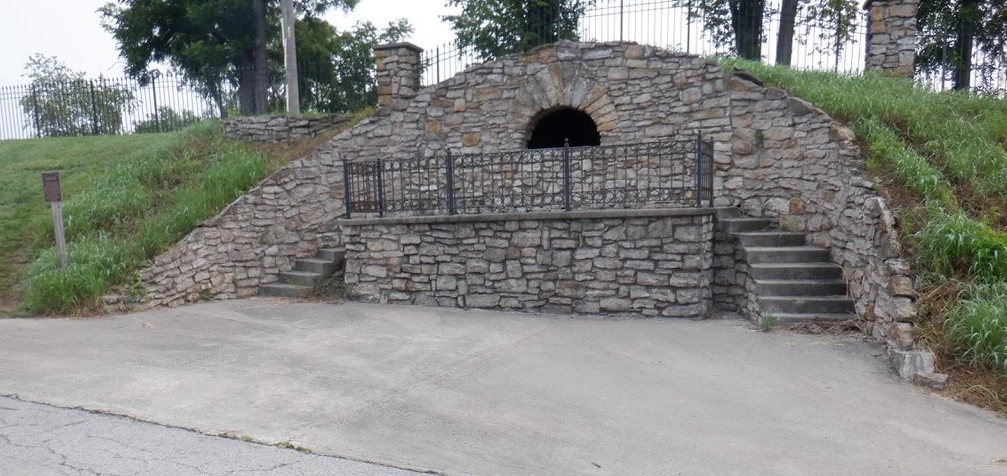
Steps were made toward the preservation and future of the Halfway House between Platte City and Weston at the Platte County Commission meeting Monday, July 6.
Director of Planning and Zoning Daniel Erickson presented a rezoning order for the property, owned by the International Union of Operating Engineers, in a step forward for the property to be preserved as a historical monument and museum. Weston’s Black Ancestors Awareness Campaign (BAAC) has helped take on the project to preserve the remaining stone basement, document the stories tied to the property, and secure its recognition on the National Register of Historic Places. The goal is not only architectural preservation but also the recovery of overlooked regional history – particularly the intertwined stories of immigrants, enslaved people, abolitionists, and frontier conflict in pre-Civil War Missouri, according to the BAAC website.
The site was originally part of a 160-acre farm owned by German immigrant Johann (John) Floersch, who arrived in the region in the early 1840s after leaving Louisiana due to conflicts with pro-slavery neighbors.
Floersch built an inn, taproom, and stagecoach stop known as the Halfway House, positioned along the Weston to Platte City toll road completed in 1849. The establishment served travelers moving by horseback, wagon, and stagecoach and became an important waypoint where people could eat, rest, and care for their horses.
Beneath the structure, Floersch constructed a large arched limestone cellar and deep stone well, built without mortar and still standing today.
Historical research has revealed that during the turbulent years leading up to the Civil War – particularly during the rise of the Fugitive Slave Act of 1850 and pro-slavery militias in Platte County – the property and surrounding area were entangled in conflicts over slavery, freedom, and abolitionist activity. One key figure connected to the site is William Tooms, a Black man who lived and worked on Floersch’s farm and whose name appears in court records tied to a violent 1851 confrontation involving pro-slavery leader Hall Wilkerson.
Though Tooms was later found not guilty, his story highlights how Black lives and experiences in early Missouri were often hidden or erased from historical narratives.
BAAC founder Angela Hagenbach spoke at the meeting.
“There’s so much history at that site that we want to learn and discover and excavate,” Hagenback said, stating there was already a three-week archaeological dig conducted at the site. The cellar is in need of stabilization, as tree roots are growing into the stone.
The commission also approved two grant awards for the Platte County Convention and Visitors Bureau, both from the Missouri Division of Tourism. The marketing management grant is a matching grant, awarded at $25,000, which will be used for a social media ad campaign. A marketing platform development grant was also approved at $10,000 and will be used to hire a professional photographer to document activities and landmarks in Platte County, to be used in future marketing campaigns. This project will be undertaken in cooperation with the chambers of commerce of Platte City, Weston, Parkville and Riverside with resulting images available for use by the county and participating communities.
Tabled at the meeting was an agreement with Gallagher for cyber liability insurance.