

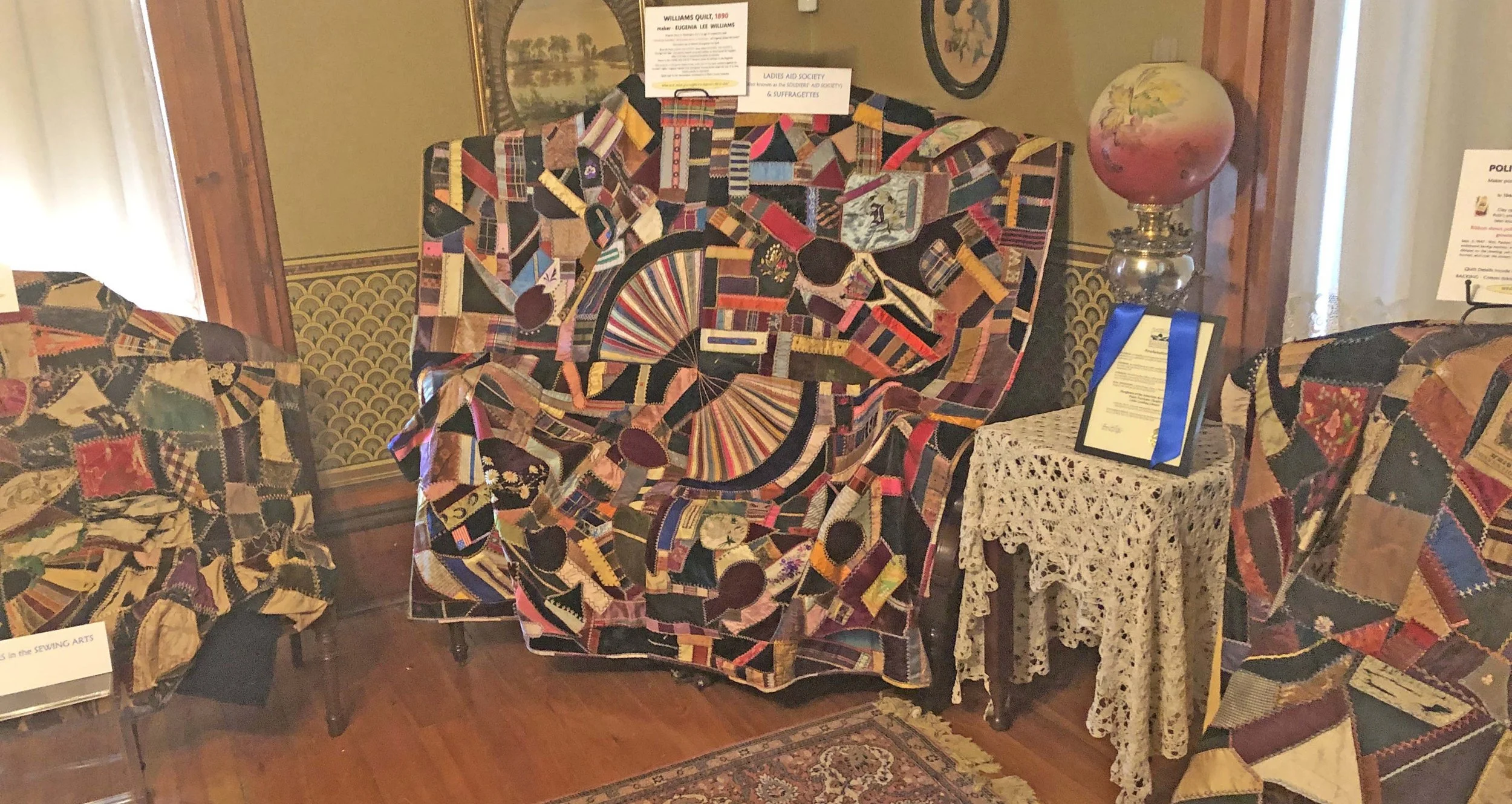
The Ben Ferrel Platte County Museum is inviting the public to view its current exhibit, Crazy Quilts and the Creative and Courageous Women Who Made Them.
It will be on display through the first week of October.
The quilt display, which began in July, includes 20 quilts and quilt pieces, which have stories that represent the local region and the U.S. from the 1880s to the mid-1900s.
“One of the items is a quilt piece from northwest Missouri,” Lisa Wittmeyer, curator at the Platte County Ben Ferrel Museum said. “What makes it interesting is that on the back, the quilter identified the origin of the fabric pieces she used such as, for one piece, as Mr. Green’s silk hat lining and another piece, as an aunt’s wedding dress, for example.”

One of the quilts on display was pieced from fabrics sold at the closing of the 1876 centennial exposition, an event that featured Japanese art and British embroidery, which helped launch the crazy quilt fad. Another quilt was made by several young girls living on farms near Weston, who appear to have been mentored in the sewing arts by an older woman who was a pioneer settler in the area.
“Some of the quilts incorporate historic items such as an 1844 silk presidential election ribbon which had been preserved in the family of the quilter for over 50 years before it was incorporated into the quilt, which was made in around 1895,” Wittmeyer said. “We have similar examples of historical ribbons in another quilt. Several of the quilts are more modern yet have stories of local historical value. Sue VanAmburg of Platte City has loaned two quilts, for example, that were made by a great aunt who worked in the Garment District in Kansas City in the 1940s-1950s. She used suit linings for her quilts. Another quilt of this time period was loaned by Anne Simpson Jones of Weatherby Lake. The quilt was made by the late Lucile Jones for her husband Max Jones who at one time was the mayor of Platte City and owner of the Landmark Newspaper. So there are historic items within the quilts and the fabrics themselves, and their uses help to represent time periods in American history.”
One of the quilts that includes historic items came from an organization that gave aid to Civil War soldiers. Some of the quilts have interesting local stories. Another was made of dress fabrics by a mother and daughter who immigrated to Missouri from England.
“Another is a section from a quilt made by the owner of a boarding house in Northwest Missouri who wrote names of people who donated the fabric pieces to her with their uses like ‘silk hat lining’ or ‘wedding dress,’ Wittmeyer said.
A spokesperson with the Platte County Historical Society which owns and operates the museum said, “We wanted to tell not only about the quilts as works of artistic self-expression, but about their creators and their lives. The quilts are full of beautiful details that tell these stories – each quilt uniquely personal yet also representative of its historical moment and a crazy quilting trend after the Civil War.”
The quilts are not only works of art, they also represent memorable points in history.
“Most of the quilts are simply decorative and notable for this,” Wittmeyer said. “The crazy quilting trend reached its zenith in the 1880s-1890s during the Gilded Age. Several of the quilts might be said to represent this age in their lavishness and saturation of fancywork. But rather than being self-indulgent for its own sake, the quilts represent the extraordinary creativity of the makers.”
Quilting remains a popular hobby and a creative way to make art to hand down to family and friends for generations.
“Unfortunately, many crazy quilts are fragile due to the silks and other fabrics used in them and they have not held up well,” Wittmeyer said. “However, the fact that they still have been passed down from generation to generation and carefully preserved shows that they are important to those who have owned them. They perhaps are not only artwork but a physical tie to the past and to family members who have come before. It is unusual for so many quilts of one type to be displayed in one place and especially for a small historic museum like ours. We are hoping that people will be inspired by the individual creativity of the crazy quilters and see also that despite each quilt’s uniqueness there are also similarities as crazy quilting was a popular folk-art movement.”
The museum is located at 220 Ferrel Street, Platte City. The exhibit can be viewed on Thursdays and Fridays ($5 for adults, free for children) from 1-4 p.m. and Saturday Aug. 16 from 10 a.m. – 1 p.m. The museum will be closed, however, on Friday. Aug 8. A finale showing of the quilts along with free truffles and refreshments will be held on Sept. 25 from 5:30-8 p.m. Additional weekend openings and evening hours will be posted to the museum’s Facebook page. Tours also are available by appointment by calling (816) 304-1627.