

When Jerry Eisterhold discovered an old book in 1978, written by the famous horticulturist, T.V. Munson in 1909, he didn’t expect that his life would head in a new direction.
Eisterhold, who loved history, was greatly influenced by the book, and it had such a positive and lasting impact on him that in 1996, he decided to open his own winery called TerraVox, which means ‘voice of the land’.
The book, Foundations of American Grape Culture, is regarded as one of the founding texts of American grape breeding, and is still considered a good source of information for people who are interested in wine-making.
American native grape species had been the focus of Munson’s research, and he devoted most of his life to collecting and documenting them.
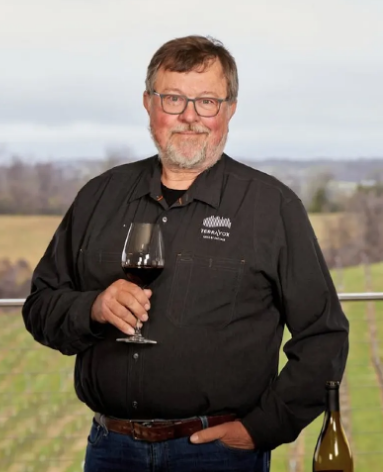
Jerry Eisterhold
TerraVox is spread over 14 acres of rolling hills in Farley, and is dedicated to sharing the history and the promise of North America’s indigenous and rare grape species.
Unlike most wineries, which specialize in a dozen or fewer popular grapes, TerraVox grows about 40 varieties. All of the grapes are native to North America and many of them are mostly unknown.
“The book gave a detailed description of ‘forgotten’ grape varietals that were dormant post prohibition,” Alyssa Groenig, Director of Sales and Marketing at TerraVox, said. “Jerry, being a historian, was fascinated by this book and viewed it as history that needed to be told. After years of milling the idea about, he began searching for a property that could tell the story of the Native North American grapes.”
With the help of a rented airplane, Eisterhold found the perfect place near Farley to start a vineyard with grapes native to the Midwest, grapes that no one had cultivated for more than 150 years. A soil scientist by training, he was drawn to the rich, fertile dirt on the Missouri River bluffs.
Prohibition was a large factor in the forgotten grape varietals’ demise. The grapes were planted all over the U.S., and were abundant in the Midwest. During Prohibition, many of the wine grapes were pulled out of the ground and destroyed, which left people with the only option of trying to locate wine from other countries. The wine they managed to obtain from Europe was made from Vinifera grapes, which then became the main source of grapes for wine made in the U.S after Prohibition ended.
Eisterhold is committed to bringing back the North American Indigenous grapes, which have been largely forgotten.
The TerraVox tasting room shares a space with the Green Dirt Farm Creamery in Weston. The TerraVox team members are dedicated to discovering the best expression of North America’s native grapes, and they have more than 40 varietals.
“We are a small but mighty team of four full-time employees, and of course Jerry,” Groenig said. “We have about three part-time people who consistently help in creating a 5-star guest experience.”
Eisterhold grew up as a Missouri farm boy surrounded by wild grapes in the lush Gasconade River Valley, upstream from Hermann, Mo., and his interest in the science of crops, soil, and environment began at an early age. Along with his parents and five siblings, he grew up making wine. His early education in agronomy at the University of Missouri enhanced his interest in the art of growing.
He and his team members at TerraVox believe their vineyard could not exist without the work of Munson, who was given credit for saving the European wine industry from utter destruction due to Phylloxera, which is an insect that feeds on, and kills grapevine roots. Traveling from North America to Europe in the late 1800s, it devastated vineyards for a long period of time. Munson promoted the strategy of grafting European vines onto American rootstock.
In the early 1980s, Eisterhold had tried to find the grapes that Munson mentioned in his book, but couldn’t find any local nurseries that offered them. He contacted someone at a community college which was close to the long-closed nursery that Munson had run in Texas. Eisterhold was eager to find out if any of Munson’s vines might still be growing in the area. He was sent a few cuttings and his plantings began.
“These grapes tell a story few have heard,” Eisterhold said. “One of resilience, rediscovery, and the roots of American wine. At TerraVox we aren’t just making wine, we’re reviving a legacy nearly lost to time. Each vine on this land carries a chapter, and every bottle is a voice speaking from the soil itself.”
Groenig said it’s a great experience when local residents find out about wines that they have never heard of, while discovering the history of wine-making in the U.S.
“Many guests visit us without much knowledge about what we offer. Our varietals are vast and it’s a lot to take in. When guests make a reservation for a guided tasting, we take a deeper dive into our story, the number of varietals, what makes us different, and how we got here. When you visit our tasting room, we have a beautiful timeline along the wall dating back to Leif Erikson. We truly are a living museum of grapes and we love sharing our story. We hope to give guests as much information as they can digest as well as provide them additional resources to take home with more history should they be interested.”
Missouri has approximately 130 wineries and vineyards. Missouri had already become a national leader in making wine, and the cultivation of grapevines by the 1860s due to its rich soil, diverse native grapes and pioneering spirit.
“Today, we continue that tradition, exploring the full potential of grapes uniquely suited to this land,” Eisterhold said.
While Munson was dedicated to saving European wine from Phylloxera, he was also an expert in North American grape species and loved grape breeding. Eisterhold is continuing Munson’s quest to discover unique flavors that North American grapes bring to wine.
The history of TerraVox is treasured by its staff. “I enjoy being a part of something uniquely special,” Groenig said. “We have an opportunity to share this beautiful story and create memorable experiences for our guests. I love that no day is the same. My joke is that this is the best cubicle ever. Our scenery is unlike any in this area. We have a great team and are all passionate about what we do so it makes it wonderful to come to work each day.”